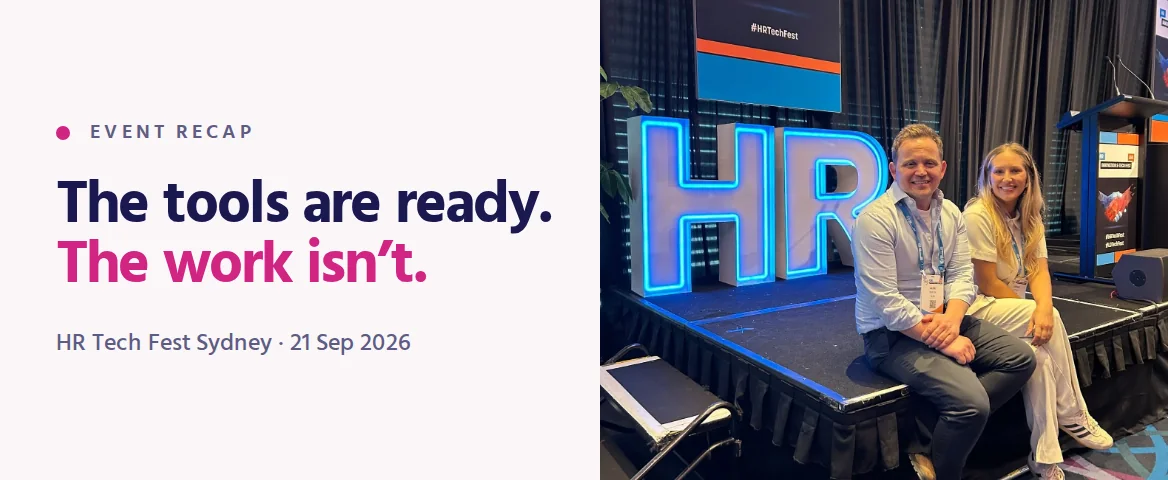

At HR Tech Fest in Sydney on 21 September, Sarah Bellett, Head of People Experience at One New Zealand, walked through roughly 18 months of AI change at a 2,500 person telco. The headline numbers were strong: 98% adoption of the AI tools they use, 52 large AI initiatives delivered, and more than $17 million returned. She was clear that the return came from growth, not from taking employment cost out of the business.
The most useful part of the talk was what didn't go to plan. We designed and built Nooma, O-HR's AI practice companion for HR professionals, and almost every lesson she shared lines up with a design decision we've had to make.
In year one, One NZ gave Copilot to everyone and launched an internal AI School. It logged close to 5,000 learning completions in six months. Personal productivity went up, but team processes stayed the same. Sarah's own diagnosis was that they over-indexed on capability because it was the clearest thing to act on, and got to the work itself too late. Their second all-company event was rebuilt around one idea: rewire the work, not the skills.
We see the same pattern from the product side. A general chat tool asks every HR practitioner to work out alone how AI fits an offboarding, an investigation or a performance conversation. Most won't. The ones who do build it differently every time. That's why Nooma is organised around the workflows themselves. The AI sits inside the step the practitioner is already on, not in a separate tab they have to remember to open.
One NZ assesses work at the task level using Stanford's Human Agency Scale. Every vacancy now goes to a recruitment forum, where leaders test which tasks in the role are likely to be automated and talk about what human work remains. The conversation moves from "replace Sarah" to "what does this role need a person for?"
Her procurement example stuck with us. The team's real value was influencing, negotiation and relationships, but their days went on synthesis and paperwork. AI took the paperwork; the people kept the relationships.
HR work has the same shape. Synthesising interview notes, drafting correspondence and checking a process against its steps can be handed off. Telling someone they've been stood down, or deciding whether conduct amounts to serious misconduct, can't. In Nooma that line is the first design decision on every workflow, not the last. The AI prepares, drafts and checks. The practitioner decides.
One NZ built an AI Confidence Agent that anyone can ask: can I do this, what are the implications, who do I need to involve? Sarah's point was that you can't set a bold ambition, build excitement, and then smother it with governance. Clear guardrails create the psychological safety to experiment without doing the wrong thing.
In HR the data is about people, often at their worst moment, so the guardrails have to live in the product rather than in a policy document. For Nooma that has meant calls like keeping advertising tracking off authenticated app pages entirely, because workplace investigation data has no business near an ad platform. Decisions like that are what let a practitioner use the tool on a live matter without second-guessing it.
Less than six months after rolling out Copilot, One NZ pulled back a large share of licences and moved people to ChatGPT and other tools. Shadow AI was telling them the fit was wrong. Some candidates now ask to bring their own AI workbench with them.
For HR, fit means a tool that understands the practice: Australian employment context, the steps of a proper process, and the documentation that needs to exist when it's done. A generic assistant can write a letter. It doesn't know which letter the process calls for next.
Sarah was candid that her people team shrank over the same years this work was asked of it. The workforce intelligence stack behind their progress was assembled from several vendors within a year. The whole effort ran as a formal partnership between People and Culture and an AI and data team, with shared KPIs.
That is a 2,500 person business with serious internal support. A 60 person business with one HR generalist, or an owner doing HR alongside everything else, has none of it. Sarah's closing advice was that nothing works in isolation, and that People and Culture should partner closely with technology. For most Australian HR practitioners, that partner doesn't exist in-house.
That gap is what Nooma is built for: the structure, workflows and judgement prompts a large organisation builds around its people team, available to the practitioner working largely on their own. See how we built it.
Sarah closed with signals, not a checklist. Adapted for HR:
If the answer to the second one is "mostly meetings", the next step isn't more training. It's picking one workflow and rebuilding it.
If you're building AI into specialist work of your own, here's how we approach it. For HR practitioners, Nooma launches to founding members soon: join the waitlist.
Book a free 30-minute call. We'll talk through what you're working on, what we'd do, and whether we should partner. No pitch deck, no PDF brochure.

Software that holds up under real use.

© 2026 Castle Digital Pty Ltd. All rights reserved.