
Most AI products in education are a general chat model with a system prompt asking it to behave like a tutor. It demos well. It rarely teaches, because tutoring is a discipline with its own craft, and a prompt is a poor place to keep a discipline.
We built OLi Tutor with Olympus Insights, the company Castle co-owns, working as technical co-founders across commercial strategy, product, design and AI engineering. The premise from day one was that the tutoring behaviour had to live in the system itself. This post is about why, and what it means if you are building AI into any specialist product.
A system prompt can ask a model to be Socratic. It cannot make the model remember that a learner struggled with the same concept last week, work out whether today's question is too easy, or decide when a topic should come back for review. Those aren't matters of tone. They are state, measurement and scheduling, and they need somewhere to live that persists between conversations.
So we started by listing what a good human tutor actually does, and treated each item as an engineering requirement rather than an adjective:
None of these are prompt features. Each one is a component with data behind it, and we built and trained the system that carries them.
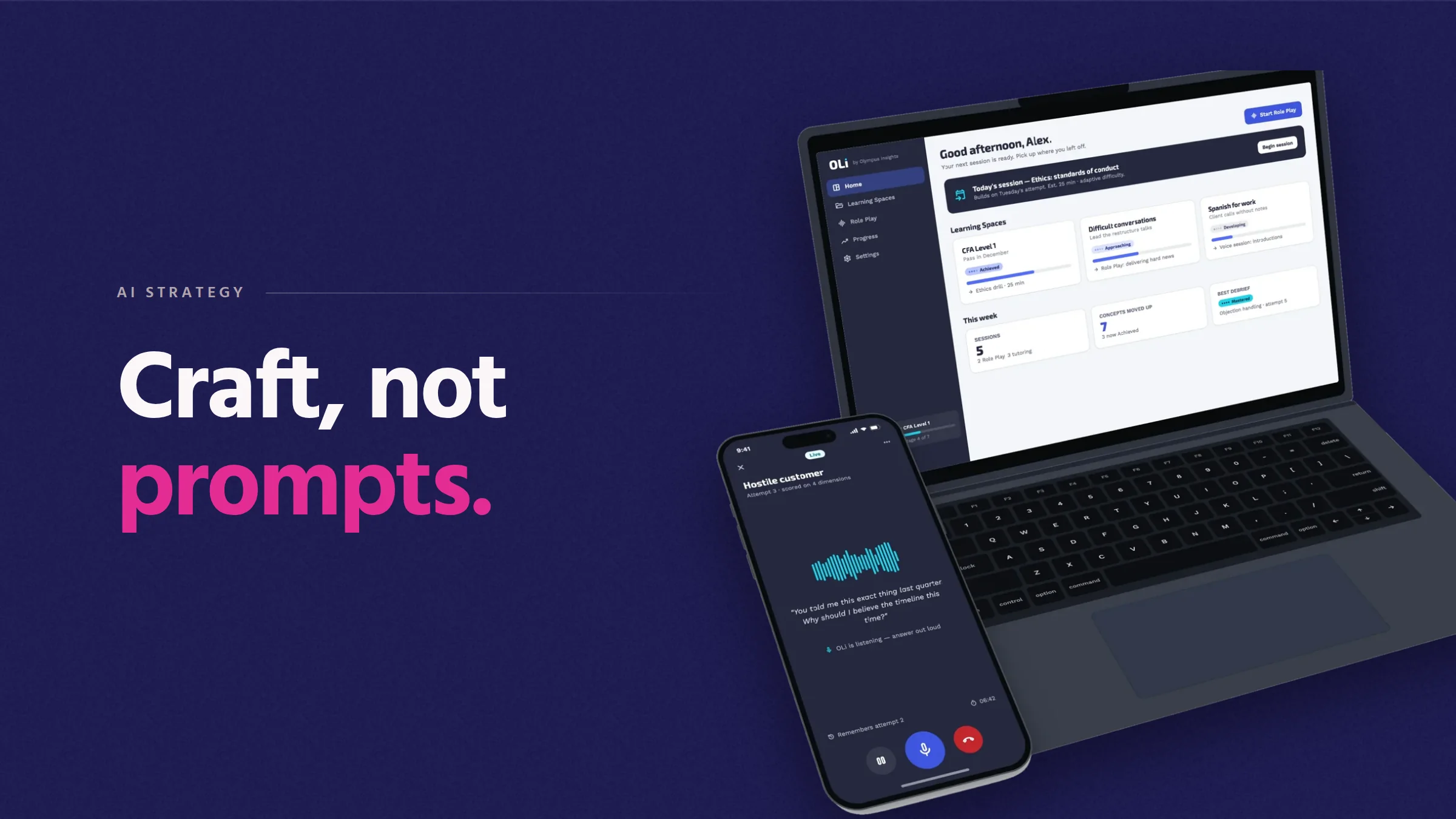
Once voice, screen share and memory were treated as primitives, the interface followed. OLi is voice-first because tutoring is a conversation. It is screen-aware because the work is on screen. Role play mode lets a learner pick a scenario, set the temperament and difficulty of the other person, and practise the conversation out loud.
Accessibility went in at the same level. ADHD-optimised sessions, dyslexia-friendly interface patterns and CEFR-aligned language tracks were designed from the first sketch, not added once the core product worked. For a tutor, the learners who find standard material hardest are the ones it most needs to serve.
A tutor on its own is a demo. A product needs authentication, onboarding, chat, voice and session management, billing, an admin portal, and analytics that an enterprise buyer will ask about in the first meeting. We sequenced sixteen foundational epics to cover exactly that, so launch did not trip on plumbing.
This is the part most AI prototypes skip, and it is usually why they stay prototypes.
The build was hard because the positioning demanded it. Consumer AI tutors compete on interface. Enterprise learning platforms compete on feature count, often by bolting generative AI onto existing infrastructure. OLi competes on teaching.
That thesis only holds if the teaching is genuinely better, and that meant investing in the system rather than the wrapper. It is also what makes the product hard to copy. Anyone can write a prompt. Rebuilding the memory, calibration and scheduling underneath it is a different job.
You are probably not building a tutor. The lesson carries anyway. If your product depends on a specialist craft, whether that is teaching, triage, case management or compliance, ask where that craft lives.
Not every feature needs this depth. A summary button can be a prompt. But if AI is the reason someone chooses your product, the craft needs to be engineered, not described.
Read the full OLi Tutor case study, or see how we approach AI in specialist products.
Book a free 30-minute call. We'll talk through what you're working on, what we'd do, and whether we should partner. No pitch deck, no PDF brochure.

Software that holds up under real use.

© 2026 Castle Digital Pty Ltd. All rights reserved.