
Back to all posts

AI Strategy

Stop Shipping AI Demos: A Practical Guide to Features That Solve Real Problems

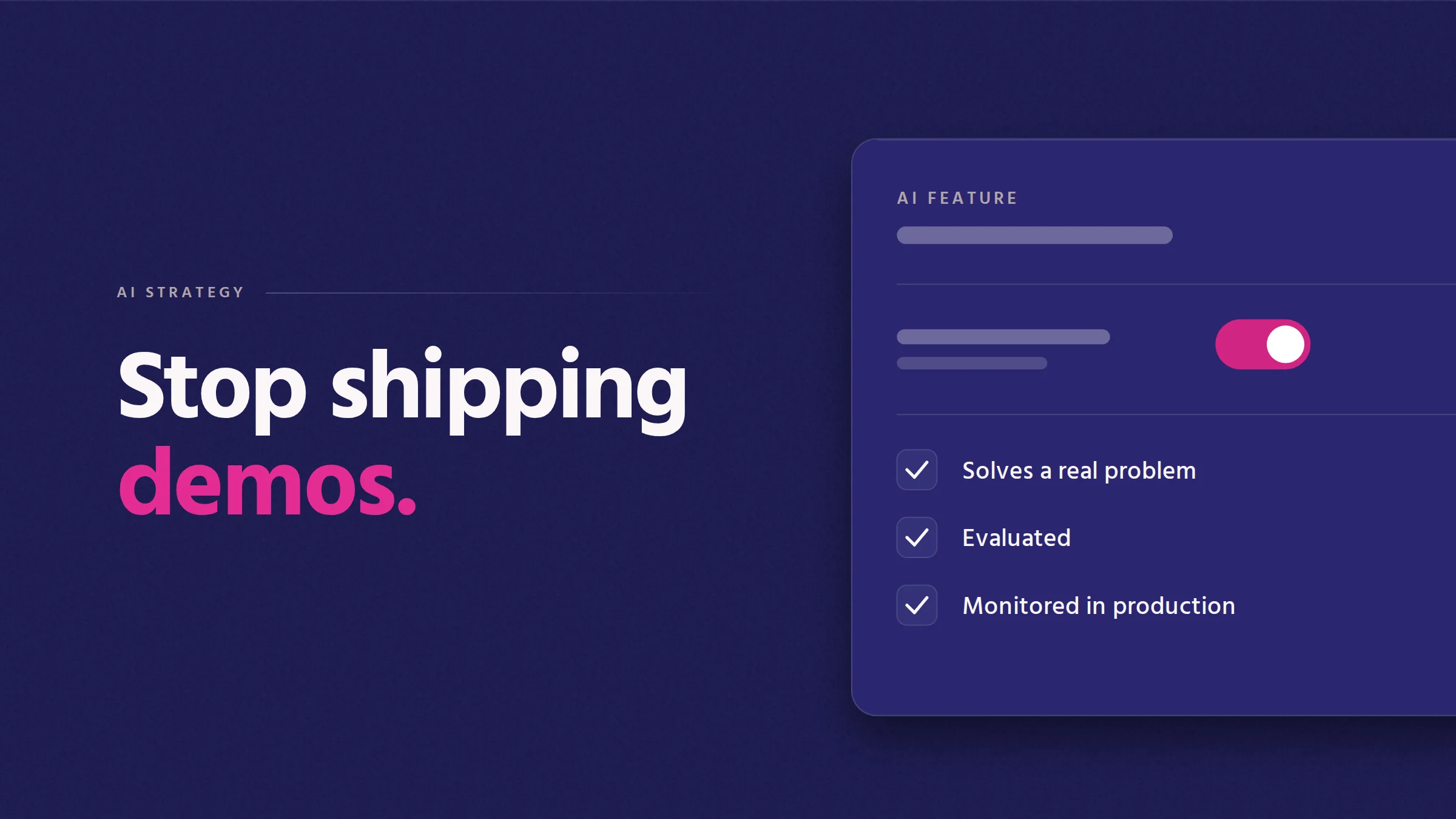
Stop shipping demos. Cover illustration: an AI feature panel with its toggle switched on and a checklist of real problem, evaluated and monitored.

A demo is built to succeed. Someone picks the inputs, runs it a few times and keeps the good take. Real users don't send the good take. They send the half-finished question, the blurry photo, the edge case nobody thought of, and they send it at the moment it matters to them.

That gap is why so many AI features look finished in a meeting and fall over in production. Closing it isn't about a better model. It's about deciding what "working" means before you build, and checking it the whole way through.

Why demos lie

A demo hides almost everything that decides whether a feature survives:

  • The inputs are curated. Nobody demos the awkward case.
  • It runs once. The same prompt can give a different answer tomorrow.
  • Nothing is at stake. A wrong answer in a demo is a laugh. In production it's a support ticket, or worse.
  • Nobody owns the result. In a demo the output just appears. In a real product, someone has to stand behind it.

Start with the job, not the model

Before anyone opens a model playground, write one sentence: who uses this, at which step, and what changes for them when it works. If that sentence is hard to write, stop there. Sometimes the better fix is a clearer workflow, a well-built form or a proper report, and no AI at all.

If the sentence holds up, it tells you what to measure. "Practitioners spend less time drafting the first version of an outcome letter" is testable. "Add AI to the product" is not.

Define "good enough" before you build

Three things to agree before the build starts:

  1. A set of real inputs. Collect genuine examples from the work, including the awkward ones. If you don't have real data yet, that is a finding in itself.
  2. What a pass looks like. Agree it with the person who will own the result, not just the team building it. For some features a pass is "accurate". For others it is "accurate, and the user can see where the answer came from".
  3. The cost of a wrong answer. A poor product description costs little. A poor answer about someone's leave entitlement or care plan costs a lot. The higher the cost, the more the feature needs a real decision point that a person owns. The decision gates in Nooma are a worked example.

Build the evaluation before the feature

Turn those real inputs and pass criteria into an evaluation set, and run it every time the prompt, the model or the retrieval changes. It's the only honest way to know whether a change made things better or just different.

Evaluation isn't only about accuracy. On Nooma, the AI practice companion we designed and built with O-HR, independent bias testing ran alongside the build, with students from the University of Sydney and the University of Melbourne and O-HR's in-house responsible AI analyst. For anything that makes or shapes decisions about people, fairness belongs in the test set from the start.

Design the failure path

Every AI feature will be wrong sometimes, slow sometimes and unavailable sometimes. Decide what happens in each case before users find out for you:

  • Let it say it doesn't know. An honest "I can't answer that from the sources I have" beats a confident guess.
  • Keep its world small. Answers drawn from a defined set of sources are easier to check and harder to get badly wrong.
  • Hand over cleanly. When the AI can't help, the user should land somewhere useful, not at a dead end.
  • Have a fallback. If the model is down, the rest of the product should still work.

Watch it after launch

Launch is where the real evaluation starts. Useful signals:

  • Do people come back to it? First-week curiosity is not adoption.
  • How much do people edit the output? Heavy editing means the draft isn't saving the time you think it is.
  • Where do people route around it? If users copy the task into a different tool, the fit is wrong.
  • What does each use cost? Model costs scale with usage, and a popular feature can surprise you.

Decide in advance when to switch it off

Write down, before launch, what would make you remove the feature. Low repeat use, heavy editing, a failure you can't design out. Most teams never do this, which is how products end up carrying AI features nobody uses and everyone pays for.

A short test before you ship

  • Can you say who it's for and what changes for them in one sentence?
  • Have you tested it on real inputs, including the awkward ones?
  • Does the person who owns the result agree with your definition of a pass?
  • Do you know what happens when it's wrong, slow or down?
  • Have you written down when you'd remove it?

If any answer is no, you still have a demo.

For the architecture that keeps AI features maintainable, see how to add AI without piling on tech debt. To see how we approach it on client work, read AI properly embedded.

Building something that should exist?

Book a free 30-minute call. We'll talk through what you're working on, what we'd do, and whether we should partner. No pitch deck, no PDF brochure.

Book a free 30-minute call

© 2026 Castle Digital. All rights reserved.