

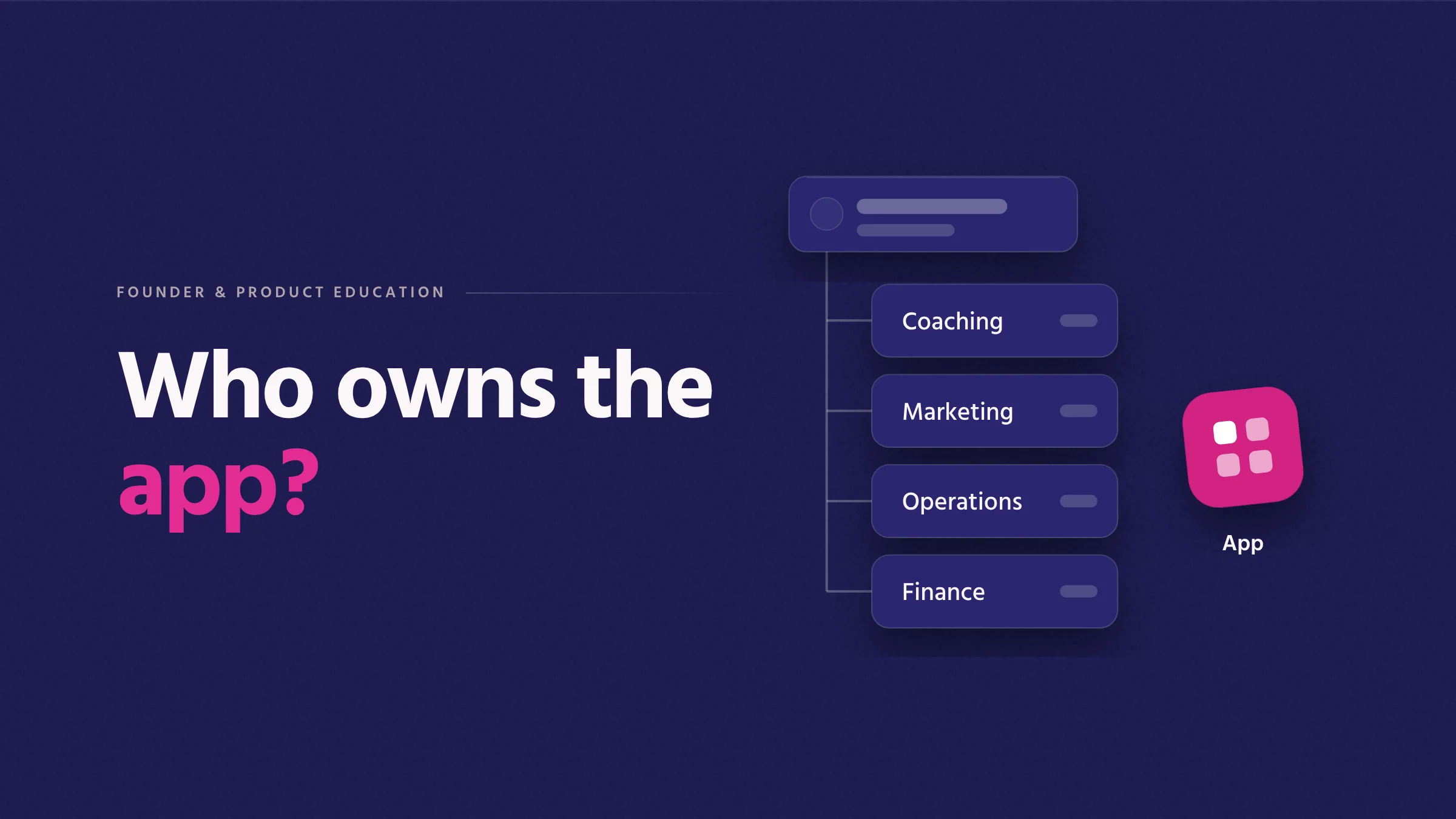
A strength coach with a subscription app. A healthcare provider whose clients book and track care through one. A training brand selling programs to members around the world. None of them are software companies. All of them sell software.
That gap is where a lot of good apps quietly go wrong. Not through one bad decision, but because nobody inside the business actually owns the product.
In a product company, the app is the business. There's a product lead, an engineering team and a roadmap someone argues over every week.
When the app supports the core offer, it looks different. The founder owns it on paper. In practice it sits somewhere between marketing, operations and whoever built version one. That might be a freelancer who has moved on, or a studio that shipped the build and handed over a login.
Customers don't see any of that. To them, the app is the business. If signup breaks, the business broke.
It rarely arrives as a crisis. It arrives as small things that compound:
Each one is survivable. Together they turn the app into something customers tolerate rather than a reason they stay.
Most businesses reach for one of three answers.
Hire a developer. You get engineering capacity without product judgement. A good developer will build what you ask for. The hard part is knowing what to ask for.
Go back to whoever built it. Fine for fixes. But teams set up to deliver a scope aren't set up to own outcomes over years.
Hire a head of product. The right instinct, often the wrong timing. It's a big commitment for a business whose core isn't software, and that person arrives with no team to lead.
None of these is wrong. Each fills one gap and leaves the ownership gap open.
Ownership isn't a headcount. It's a set of jobs someone has to be accountable for.
Bulletproof for BJJ owns one of the most respected strength and mobility methodologies in grappling: twelve movement categories, graded white belt to black belt. Their business is coaching. The app delivered good programming to paying members, but the methodology itself lived in coaches' heads and PDF charts.
Underneath sat practical problems. Subscription states didn't always reflect what members had paid across three app stores. Signup had authentication bugs. The product ran slower than the coaching inside it deserved.
We started below the waterline: the data model, authentication and subscriptions. Then we built an assessment engine that turns the methodology into product logic, with analytics going in alongside it rather than after. Product strategy and roadmapping ran next to delivery, so commercial and delivery decisions came off the same numbers.
The app now prescribes rather than publishes. A member finishes onboarding knowing where they stand and what to train next. Read the Bulletproof case study.
If more than a couple of those make you uncomfortable, the app doesn't need more features yet. It needs an owner.
Our Strategy & Audit is a fixed-price look at where your product stands, what to keep and what to fix first. Or book a free 30-minute call and talk it through.
Book a free 30-minute call. We'll talk through what you're working on, what we'd do, and whether we should partner. No pitch deck, no PDF brochure.

Software that holds up under real use.

© 2026 Castle Digital Pty Ltd. All rights reserved.