All work
PRODUCT STRATEGY · UX/UI DESIGN · PLATFORM TAKEOVER
Evolving a school engagement platform into something regulators, schools and families could all trust.
Supporting, maintaining and significantly evolving a live school and family platform.
PRODUCT STRATEGY · UX/UI DESIGN · PLATFORM TAKEOVER
Supporting, maintaining and significantly evolving a live school and family platform.

CLIENT
Kudos Kids & Co Pty Ltd
YEAR
2024 to ongoing
SECTOR
EduTech, primary and early learning
SCOPE
Support and maintenance · Product strategy · Compliance · R&D funding · Ongoing development
PLATFORM
iOS · Android · Chromebook · Windows · Web
TECHNOLOGIES
Flutter · Google App Engine · Firebase · Stripe
SHARE THIS
THE BRIEF
Kudos Kids is a closed platform for schools and families. Teachers and students share photos and videos of learning as it happens, families see it, and that is where it stops. No public profiles, no discovery, no open feed, nothing that behaves like a social network.
Two things make it different from the parent communication tools schools already have.
The first is that children use it themselves. Students post their own work from classroom devices, which means a child gets to choose what they are proud of rather than having an adult decide for them. Everything they post goes to a teacher for approval before anyone outside the classroom sees it.
The second is the village. A child's school life does not only matter to two parents. Grandparents, aunts, uncles and separated or interstate family can all be given access to that child's learning, each under the same permission rules. For a grandparent in another state, it is often the closest thing they get to being in the room.
The first version was built by another development partner. By the time Kudos Kids engaged Castle Digital, the platform was live and in daily use with Australian schools, and the brief was continuity first. Support it properly, maintain it reliably, and take it further.
Underneath all of it sits the constraint that defines the product.
A classroom photo sounds like a simple thing to share. Then you look at who is in it. One image might contain twelve children. Four have no photo consent on file. They come from three different classes. Each family has an absolute right to see their own child and no right at all to see anybody else's. Widen the audience to a whole extended family and that problem gets harder, not easier.
Every change we make has to pass that test. It rules out a surprising number of features that look obvious on a whiteboard, and it is the reason this product cannot borrow patterns from anywhere else.
OUR APPROACH
Taking on a live platform is a different discipline to building one. There is no discovery phase when teachers are relying on the thing every Monday morning. We started by running support, learning the system in detail and giving schools a direct line to raise issues, which is also the fastest way to understand what actually matters to a teacher.
Once the platform was in a state where it could be changed safely and predictably, we started proposing where it should go rather than only responding to what came in.
Castle Digital sits in the product decisions, not just the delivery ones. Roadmap, prioritisation, feature scoping, pricing and packaging, go-to-market thinking, competitive positioning. When something is not worth building we say so, and when the commercial case for something is stronger than the technical case we say that too. Kudos Kids gets a product function without having to hire one.
We prepared and supported the R&D Tax Incentive submission, documenting the technical uncertainty and experimentation behind the platform's harder engineering problems. That rebate returns a meaningful share of development spend to the business, which for an early stage EduTech company is the difference between one roadmap and a considerably more ambitious one.
Selling into Australian schools means clearing a regulatory bar before you get anywhere near a purchasing conversation, and that bar has moved significantly during our time on the platform. We build that work into the roadmap ahead of deadlines rather than reacting to them.

WHAT WE BUILT
Per-child access sitting behind a parental gate, an in-app safety prompt before a child shares, and full teacher moderation of student posts and comments. Built to meet Google Play's Families Policy requirements for apps used by children, and kept because it is the right design regardless.
Children capture photos and video of their own work on school devices, tag it to their learning, and submit it. Nothing reaches a family until a teacher approves it. The whole flow is built for a Year 3 student on a Chromebook, not an adult on a phone.
A primary family account holder manages consent and receives teacher communication, while additional family members can be granted view access to that child's learning. Grandparents, aunts, uncles and family living elsewhere stay connected without anyone gaining access to another family's child.
Private written updates between one teacher and one family about one child. Never visible to students, never visible to other families. Since extended so parents can start the conversation, with the architecture deliberately designed to upgrade into full messaging without rework.
Specialist teachers cover art, music, PE and languages across an entire school. Principals are administrators and classroom teachers at once. Many teachers are also parents at the school they work in. All three required schema level change, and all three now work without anyone logging out and back in.
Children without consent on file are flagged to teachers and excluded from family-facing content automatically. The check happens before publication rather than after a complaint.
Per-student subscription billing through Stripe across monthly and annual terms, invoicing, renewal handling, and a super admin layer so the Kudos Kids team can manage schools directly.
Image and video handling, caching, load time work and Chromebook support, because a Chromebook cart is what most Australian primary classrooms actually run. One Flutter codebase covers iOS, Android, Chromebook and Windows.
Product instrumentation with no personal information in event parameters, ad personalisation disabled and pseudonymous identifiers for student accounts. Kudos Kids can see how the product is used without ever tracking a child.
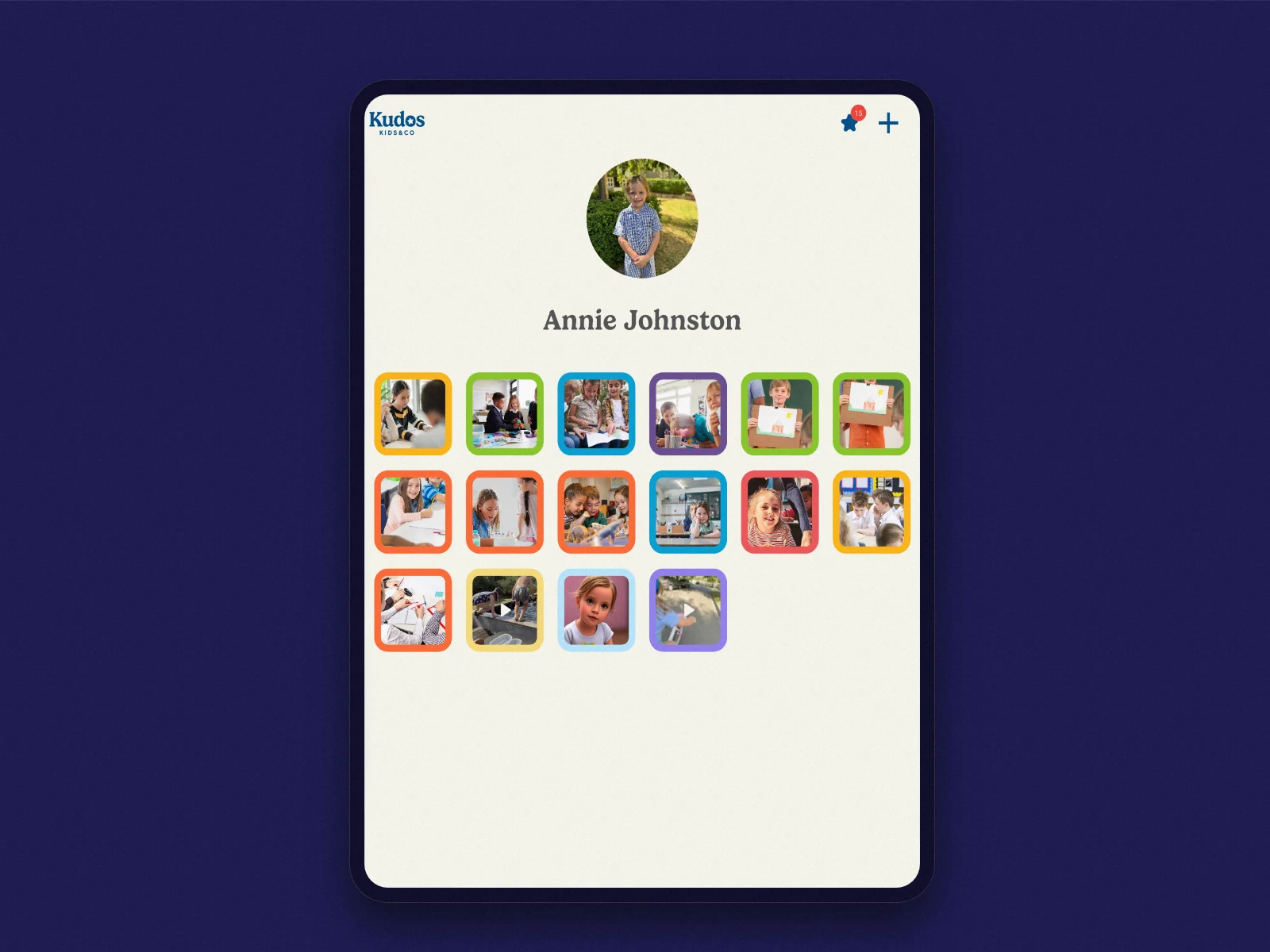
The classroom gallery, with every image governed by the consent layer underneath it.
WHAT CHANGED
Multi-class teachers, dual-role principals and teachers who are also parents were all blockers to adoption beyond the simplest school structures. They are no longer.
Kudos Kids is assessed under ST4S, the national Safer Technologies 4 Schools framework most state education departments use as a screening gate. It meets Google Play's Families Policy requirements for apps used by children. Work against the Children's Online Privacy Code started well ahead of its December 2026 commencement. And because the product has never had public profiles, discovery or child-to-child messaging, Australia's under-16 social media restrictions were never a threat to the model.
Teachers could always share learning. Families can now respond, and start conversations of their own, inside the same moderated environment.
The R&D Tax Incentive rebate returns a share of engineering spend to the business each year, extending what the roadmap can absorb without additional capital.
Subscription billing, invoicing and school administration now support a self-serve onboarding motion rather than a manual one, which is the precondition for scaling past direct outreach.
If you have a live product and a development partner you have outgrown, we have done this before. Taking over someone else's platform is a specific discipline, and it is mostly about restraint early and judgement later.

Book a free 30-minute call. We'll talk through what you're working on, what we'd do, and whether we should partner. No pitch deck, no PDF brochure.
Book a free 30-minute call
Book a free 30-minute call

Software that holds up under real use.

© 2026 Castle Digital Pty Ltd. All rights reserved.